Below is a link from Albert Mohler.com that ought to be of concern to every Christian that supports Wold Vision
http://www.albertmohler.com/2014/03/25/the-briefing-03-25-14/
Below is a link from Albert Mohler.com that ought to be of concern to every Christian that supports Wold Vision
http://www.albertmohler.com/2014/03/25/the-briefing-03-25-14/
The goal of the ministry has always been to impact the Church with Reformed Theology. Our usual way, like our friends at Ligonier, has been through the promotion of conferences, blogs, podcasts, book distribution and home school events. In touching others we have been blessed with the privilege of facilitating others to help us reach out.
In the past few years, we have been quietly working with the Canadian Armed Forces. One of our supporting members is a commissioned officer in the Chaplaincy Corps. Over the years he has been posted at a number of Canadian Forces Bases. He and I have enjoyed many a conversation about the challenges and joys of serving Christ as a chaplain in the military. In recent years, he has relayed to me the very real struggle soldiers face coming home having faced live fire combat situations. For these heroes, Post Traumatic Stress Disorder is an all too real part of their repatriation. Please pray for these loyal Canadians and their families.
While moving from posting to posting, our supporting member has purchased literally dozens of sets of Ligonier tapes, videos and books. At each posting he has shared his faith as well as Reformed Theology with the troops. And at each posting, he intentionally left his library behind in order that these resources might be put to good use by subsequent generations of soldiers. It will be glorious to see in eternity what fruit this faithful witness has produced.
In recent years, Sola Scriptura’s involvement with the military has been upgraded substantially. We have been approached and have delivered dozens of Reformation Study Bibles, hundreds of pocket sized Bibles, dozens of New Testaments, evangelistic tracts, apologetic material, Bible study aids, commentaries and counseling material. This past week alone we shipped nearly 14 cases of material to CFB Gagetown. The good news is that the soldiers are reading this material and are open to hearing the Gospel of Jesus Christ. There have been some great phone conversations with the quartermasters of the Infantry School and the Combat Training Center. As I said earlier, it will be wonderful to see what fruit these efforts have wrought. Please pray that in the days ahead that our Sovereign God will use these efforts to build His Kingdom to the praise and glory of His Risen Son, Jesus Christ.
We are pleased to announce that Dr. Stephen Lawson has accepted an invitation to speak in Southern, Ontario. The date is September 12. Location to be confirmed.
In Vancouver, on October 25, 2014 Dr. Don Whitney will be at Cloverdale Baptist Church to walk us through a seminar on establishing solid biblical disciplines.
The Bible and Abortion
The late John Murray said, “Nothing shows the moral bankruptcy of a people or of a generation more than disregard for the sanctity of life.”[1] Abortion is an indicator of the moral bankruptcy of people in this generation and demonstrates the exceeding wickedness of sin. The Bible reveals that man is created in the image of God, and therefore to murder man is to assault the divine majesty.[2] The fact that man is created in the image of God is not true only of healthy adults, but is true of man in every phase of his life. Man is the image of God before the fall into sin (Gen 1:26-28), after the fall into sin (Jas 3:9), in the womb (see below), as a child (Lev 18:21; Eph 6:4), as one physically handicapped (Lev 19:14; Mk 10:46-52), as an elderly person (Lev 19:32; Prov 16:31; 1 Tim 5:1), and as having dominion over the animals (Gen 1:28; Ps 8:6-8).
With specific reference to the preborn, the Bible speaks of nations coming from the womb (Gen 25:18-23). Job highlights the providence of God in his life which began in the womb (Job 10:8-12; cf. also 31:13-15). When David confessed his sin before God and traced his native depravity, he did so to his mother’s womb (Ps 51:5). David was not suggesting that marital intercourse was sinful, but that at the moment of conception he (David, not a product of conception) was a sinner. The Psalmist marvels at the omniscience and omnipresence of God in Ps 139 and in verses 13-16 he rehearses God’s power in creating man in the womb. The Prophet Jeremiah was called from his mother’s womb (Jer 1:5) as was the Apostle Paul (Gal 1:15). In the birth narrative concerning Christ recorded in Luke’s gospel, John the Baptist was called “the babe” in verse 41 which is the same word used in Lk 18:15 for “out-of-the-womb” children. In Lk 1:44, Christ is referred to as “Lord” while in the womb! If the modern proponents of abortion had their way and successfully influenced Rebekah, Job’s mother, David’s mother, Jeremiah’s mother, Mary, and Paul’s mother with the propaganda of “choice,” nations would not have been, Job, David, Jeremiah, and Paul would not have been, and all of us would have died in our sins.
The Bible does not only reveal the dignity of man; it also regulates conduct with reference to man. When we understand the personhood of man as summarized above, we must understand that every prohibition given regarding murder, applies equally to babies in the womb. In addition to this, there was a specific case law given in Ex 21:22-25 that demanded punishment for those who would inadvertently murder a baby in the womb. The law specified that if two men got into a fight and during the fight a pregnant woman was struck, if she went into premature labor and her children (the word is plural) came out (the OT language for birth) but were not harmed, then the guilty man had to pay a fine. If however, the children came out and there was harm to mother or children, then the guilty man was subject to the lex talionis (the law of retaliation) up to and including death for the guilty man. Before our modern sensitivities are violated by such a proposal, remember that most nations operate according to the lex talionis principle today; it is the basis upon which we say “the punishment must fit the crime.”
In light of this particular passage, it is interesting to note that the Bible demands increased protection for the preborn. If men engaged in a fight were held legally accountable and punished for accidentally causing an abortion, how much more are state-licensed, government subsidized abortion “clinics” guilty of this horrendous crime? John Calvin rightly commented, “If it seems more horrible to kill a man in his own house than in a field, because a man’s house is his place of most secure refuge, it ought surely to be deemed more atrocious to destroy a fetus in the womb before it has come to light.”[3] Solomon records what God hates in Prov 6:16-19 and one of them is applicable to the abortion situation: “hands that shed innocent blood.”
Finally, abortion should be criminalized by the state. Not all sin is necessarily crime (covetousness), nor is all crime necessarily sin (preaching Christ in a Muslim nation), but abortion is both sinful and criminal. The modern state rightly applies the 6th word, “You shall not murder,” in most situations. In order to be consistent, abortion must be a criminal offense which is punishable by the governing authorities, not paid for by the governing authorities with monies collected through taxation.
[1] John Murray, Principles of Conduct (Grand Rapids: Eerdmans Publishing, [1957] 1984), 122.
[2] Geerhardus Vos, Biblical Theology: Old and New Testaments (Grand Rapids: Eerdmans Publishing, re. 1991), 54.
[3] John Calvin, Calvin’s Commentaries, Volume III (Grand Rapids: Baker Book House, re. 1996), 42.
In an article published at the Huffington Post, Pope Francis has gone on record to say that all men everywhere are redeemed by the finished work of Christ, even atheists. The Pontiff claims that evidence of redemption are clearly visible whenever and wherever someone performs deeds of goodness and charity. Here is the quote:
“The Lord created us in His image and likeness, and we are the image of the Lord, and He does good and all of us have this commandment at heart: do good and do not do evil. All of us. ‘But, Father, this is not Catholic! He cannot do good.’ Yes, he can… “The Lord has redeemed all of us, all of us, with the Blood of Christ: all of us, not just Catholics. Everyone! ‘Father, the atheists?’ Even the atheists. Everyone!”.. We must meet one another doing good. ‘But I don’t believe, Father, I am an atheist!’ But do good: we will meet one another there.”
In response to this assertion Father James Martin, S.J, makes the following curious statement:
“Pope Francis is saying, more clearly than ever before, that Christ offered himself as a sacrifice for everyone. That’s always been a Christian belief. You can find St. Paul saying in the First Letter to Timothy that Jesus gave himself as a “ransom for all.” But rarely do you hear it said by Catholics so forcefully, and with such evident joy. And in this era of religious controversies, it’s a timely reminder that God cannot be confined to our narrow categories.”
A number of things come to mind that require comment:
The first, is has Rome departed from its Soteriological position? Or, in other words, has its view of Salvation radically changed since the Counsel of Trent? At Trent, Rome affirmed that regeneration takes place at Baptism and is therefore efficacious for salvation provided no mortal sin is committed. Once a mortal sin is committed, the regeneration at Baptism is undone placing the soul in danger. It is at this point in Roman theology that Faith comes into play enabling the person to perform meritorious deeds in order to work themselves back into a place of Grace. Meritorious deeds include things such as the Rosary, indulgences, pilgrimage, acts of confession along with assorted acts of penance.
Second, if these human acts are necessary to work oneself back into a state of Grace, then how does the Atheist, or Buddhist, or whatever continue on in the road of penance? Do they avoid Purgatory? Or is their stay in Purgatory a little longer than your run of the mill good Catholic because they under the watch care of Catholic Diocese?
Third, how does this affect the so-called dialogue between Protestants and Catholics begun at ECT in the early 90’s? According to the proponents of ECT Catholics view Protestants as misguided or misinformed brothers. Curious when one considers that at ECT Rome did not repudiate Trent nor did the signatories repudiate Sola Fidei, Sola Gratia or Solus Christos. Somehow no one recognized that you cannot have two paths of salvation when only one is clearly delineated in Scripture.
From where we sit, it appears that Rome still does not understand the Biblical teaching of Salvation that comes through the finished work of Christ by Grace through Faith. Nor does Rome appear to understand its own historical position of Salvation. What we have here is biblical vacuity and the embrace of early 20th century Liberalism. It is a form of Social Gospel dressed in vestments and administered by the most public so-called christian face on the planet.
This is not altogether a bad thing. Hopefully, there are enough conservatives within the church that will hold the Pontiff responsible for his comments. Better still would be if the church held up Pope Francis assertions in the light of Scripture and come to the conclusion that the “Wild Boar” mentioned in Exurge Domine by Leo X had it right all along.
The Grace of Godliness-Matthew Barrett from credomag.com on Vimeo.
In this new interview, Matthew Barrett talks about his most recent book, The Grace of Godliness: An Introduction to Doctrine and Piety in the Canons of Dort. Barrett is Assistant Professor of Christian Studies at California Baptist University (OPS) and executive editor of Credo Magazine. Michael A.G. Haykin has written the foreword to the book, and here are some of the book’s commendations as well:
By reducing the discussion of Calvinism and the doctrines of grace to the simplified acrostic T-U-L-I-P, I’m afraid we have generated far more heat than light. A book that looks deeply within, behind and around the five points of Calvinism is long overdue. Whether you find yourself saying “Yea” or “Nay” to the five points, we all need to say thank you to Dr. Barrett for his delightful, informative and light-generating book.
Stephen J. Nichols, Research Professor of Christianity and Culture, Lancaster Bible College, Lancaster, Pennsylvania
Wow! I really like this book. Matthew Barrett has given us history, theology, ministerial counsel and impetus to true piety in this treatment of the Synod and Canons of Dort. The brief but vibrant historical accounts are informative, his guidance in some thick theological discussion is expert, and his focus on piety leads us to the true purpose of all theology—the production of a sincere and pure devotion to Christ. Dr. Barrett’s continual insistence on the necessity of monergism for a truly biblical grasp of the character of salvation from beginning to end is a much needed emphasis for contemporary evangelicalism. The appendices provide valuable source material. This is an excellent account of a vitally important subject.
Tom J. Nettles, Professor of Historical Theology, The Southern Baptist Theological Seminary, Louisville, Kentucky
Matthew Barrett offers a wonderfully simple and direct exposition of one of the more misunderstood confessions of faith. The Canons of Dort are often vilified, but under closer examination Barrett demonstrates that they are biblical and pastoral and a potent tonic for a flagging faith. Tolle et lege, take up and read!
J.V. Fesko, Academic Dean, Professor of Systematic and Historical Theology, Westminster Seminary California
Matthew Barrett has given us a thoroughly enjoyable introduction to and review of the history and the source documents of the Calvinist-Arminian debate. And with that he has given us a vivid reminder that a right understanding of these doctrines—in themselves considered and in the minds of the framers of the Canons of Dort—is indispensable to Christian worship and devotion. Highly recommended.
Fred G. Zaspel, Pastor, Reformed Baptist Church; Professor of Systematic Theology, Calvary Baptist Seminary, Lansdale, Pennsylvania
Christians speak freely and often about the Canons of Dort and the international synod of 1618–1619 which produced them without really knowing much about either. Matthew Barnett’s The Grace of Godliness will do much to remedy this lamentable situation. In a very accessible manner, referring to a number of important background documents, Barrett provides the historical context of the Synod of Dort. He also makes a solid case that the Canons themselves are filled with careful biblical reflection, wise pastoral application and exhortations to a warm and genuine Christian piety. Dort’s stalwart defense of divine monergism in the salvation of sinners does not produce a fear of God, lack of assurance of one’s salvation or indifference to good works—as critics often charge. When read and understood, the Canons of Dort present the so-called doctrines of grace as the foundation for a believer’s confidence in God’s mercy and, as the consequence, the basis for a life of gratitude.
Kim Riddlebarger, Senior Pastor, Christ Reformed Church (URCNA), Anaheim, California; co-host of the White Horse Inn radio broadcast
Matthew Barrett has produced an excellent and much-needed treatment of the intimate connection between the Canons of Dort and vibrant Christian piety. Whatever the readers’ attitude toward those canons, this book will reward them with greater understanding and appreciation of the spiritual richness and practical value of Reformed theology. I highly recommend it.
Steven B. Cowan, Associate Professor of Christian Studies, Louisiana College, Pineville, Louisiana
By breathing new life into historic events, documents and people, Matthew makes them speak to our culture, our churches and our hearts.
David P. Murray, Professor of Old Testament and Practical Theology, Puritan Reformed Theological Seminary, Grand Rapids, Michigan
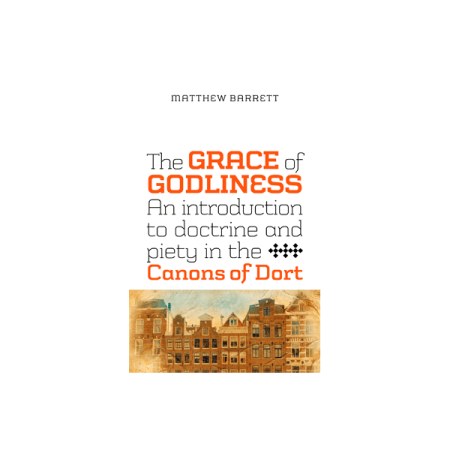
To many Reformed congregations, the Canons of Dort represent a major summation of what they believe are the true representations of Christian Doctrine. Matthew Barrett’s work has three major strengths that make this a valuable tool for today.
First, it presents a succinct historical snapshot of the circumstances, people and issues that required the Synod to meet and address errant theology. Second, the doctrines are analyzed against the tapestry of Scripture. These two elements by themselves represent an excellent study of historical theology. The book excels in the fact that third, it presents these two elements as not mere exercises of sterile orthodoxy. The Canons of Dort, in the minds of the framers, believed that these doctrines were vital for Christian living. They needed to not only shape concepts of Truth but transform lives into Godly followers of Jesus Christ. This book will truly warm the heart.
Several years ago Joshua Press released the biogrpahy of Don Heron entitled U-Turn in the Fast Lane. Don’s testifies that while he started life well, in a Christian home, by a father who himself was a minister of the Gospel, he like the Prodigal Son in Luke 15 fell into a life that was at total odds to his routes and upbringing. Don eventually found himself involved with one of the largest auto theft syndicates in Canada while at the same serving as a crime prevention officer. This is an amazing story of Grace, Mercy and Redemption.
Below is a link to our YouTube channel with the full contents of Don’s miraculous story.
U-Turn in the Fast Lane – Author Interview – Don Heron
The late Christopher Hitchens once wrote, “…Anyone who has ever seen a sonogram or has spent even an hour with a textbook on embryology knows that the emotions are not the deciding factor [in abortion]. In order to terminate a pregnancy, you have to still a heartbeat, switch off a developing brain, and, whatever the method, break some bones and rupture some organs.” These words come from his “Minority Report” column in The Nation written in April 1989.
Because Hitchens’ words are a correct assessment of the essence of abortion, it must necessarily be banned because it is the taking of a human life. If murder is illegal, so should abortion be. In Canada, we have no abortion laws; something unheard of in western democracies. And worse, our government will not release statistics about abortion, so citizens cannot know how many occur in Canada per year, under what circumstances, and why. Under the Canadian Criminal Code, a fetus in the womb is not considered a human. And our politicians, virtually from all of the major political parties, remain adamantly non-committal.
Thankfully one Canadian MP, Steven Woodworth, has put forward Motion 312 that seeks only to put the question of abortion law back on the table for public debate. Even this bill—which is not about banning abortion—is slowly being quashed by all members of parliament including Prime Minister Harper. Not only is this a blight on Canada in terms of our country’s failure to protect our most vulnerable, but it is also a sham of free speech and public discourse.
A new website has been set up called Pass 312 that seeks to promote this bill among Canadians, and to suggest ways to help make this an issue that Canadian politicians will wake up to. The question of when human life begins, and the corresponding consequences for law, needs to be discussed both by average Canadians and by our elected officials on Parliament Hill. Please click the link, read the material, and watch the videos to get informed.
I emailed my local MP, Bob Rae, these words: “Dear Mr. Rae, I live right near your office in downtown Toronto and pass by it daily. As a member of your riding, I ask you to support Motion 312 and to defend the lives of innocent children in the womb. Thank you, Ian Hugh Clary.” I emailed something similar to Prime Minister Harper’s office. If you want to email your local MP, click here and if you want to email the Prime Minister click here. I wrote it in haste, and I now wish that I had said more about free speech and public debate. Be that as it may, my letter was sent, and here is the response that came from his office:
Dear Ian Hugh Clary:
On behalf of Liberal Leader Bob Rae, I would like thank you for your email regarding Conservative MP Stephen Woodworth’s motion, M-312, regarding Canada’s abortion laws.
It is the longstanding view of the Liberal Party of Canada that women must have the right to choose, and this party will take no step that limits, or opens the door to limiting, access to safe medical services for women across Canada. It is for this reason that Mr. Rae will be voting against this motion when it comes before the House of Commons.
We understand this issue stirs extremely strong feelings and the Liberal Party respects the right of every Canadian to express their views freely and openly, no matter how contrary those views may seem to those of others.
Thank you for taking the time to write to the Leader of the Liberal Party.
Yours sincerely,
Colin McKone
Office of the Liberal Leader
I am glad that Rae’s office wrote back, and it doesn’t appear to be some vague automated response. Thus far I have not heard from the Prime Minister’s Office. But I must say that Mr. McKone’s reply does not at all deal with the issues at hand, and is quite frankly rather banal. Bill 312 is about bringing the issue of when human life begins up for discussion in parliament. Does Mr. Rae have a problem with that? If so, why? Maybe the result of the public discussion will result favourably to the Liberal Party position on abortion? He won’t know if it is not discussed. So much for transparency.
I wonder if he and his party fears that Canadians will become educated as to when human life begins, and whether abortion is indeed the taking of a human life. Maybe they will learn that a fetus is a human life, as says Dr. Jerome LeJeune, Professor of Genetics, University of Descartes, “After fertilization has taken place a new human being has come into being. [It] is no longer a matter of taste or opinion…it is plain experimental evidence. Each individual has a very neat beginning, at conception.” This perspective on fetal life is affirmed by a significant number in the medical community. Consider these words by C. Christopher Hook, M.D., Oncologist, Mayo Clinic, Director of Ethics Education, Mayo Graduate School of Medicine: “When fertilization is complete, a unique genetic human entity exists.” Professor Micheline Matthews-Roth, Harvard University Medical School writes, “It is incorrect to say that biological data cannot be decisive…It is scientifically correct to say that an individual human life begins at conception.”
Paul Harvey (1918-2009) was a long-time common sense radio conservatie commentator who developed a loyal following of listeners through his long running radio program The Rest of the Story as well as though his daily show on ABC News and Comments. Below is a link to a poignant three minute broadcast called If I Were the Devil. A prophetic piece in many ways yet as relevant today as it was when it first aired in 1965.
 Sola Scriptura